



Sorry, no records were found. Please adjust your search criteria and try again.
Sorry, unable to load the Maps API.
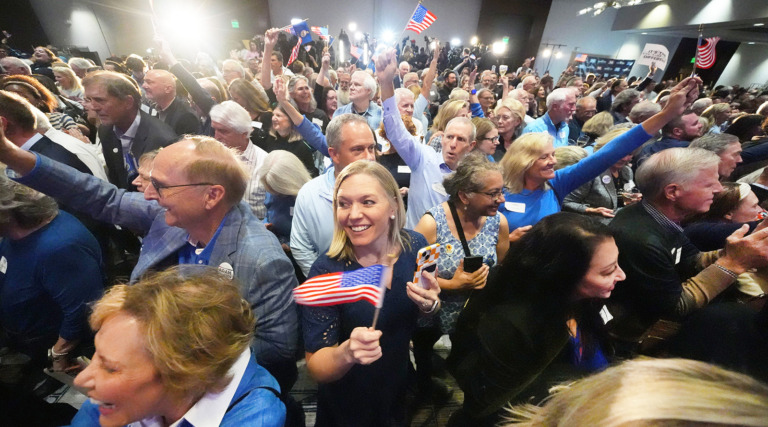
There has already been a fair amount of head-scratching in Republican circles this morning as the scale of the party’s defeat in America’s midterm elections became clear, and one suspects that President Donald Trump, who has never been particularly enthusiastic about losing anything, will have found the results especially difficult to digest.
Having returned to the White House just two years ago with considerable confidence and an apparently renewed political mandate, Trump now faces the extremely unappealing prospect of a Democrat-controlled Congress, with opponents who will be only too pleased to remind him that the American electorate has a habit of regularly changing its mind, and sometimes with spectacular consequences.
However you look at it, the scale of the Democratic advance has been remarkable, with victories in states such as Texas, Kansas, Iowa and South Carolina suggesting something far more substantial than just the usual midterm correction, and although there will be competing explanations over the coming days, concerns about the economy, rising living costs and the war with Iran have no doubt combined to produce a comprehensive rejection of the administration’s present direction.
Well, maybe. Whether last night’s result actually amounts to an enthusiastic endorsement of the Democrats is up for debate, since electorates are perfectly capable of rejecting one set of politicians without being at all impressed by the alternatives, and governments too have a habit of discovering that electoral confidence can evaporate remarkably quickly when ordinary people feel their lives are not getting any easier.
Closer to home, the result is also very likely to have reflected the increasingly uncomfortable relationship between the US Catholic Church and the political movements that seek to claim its unstinting support.
Over the past decade, mainstream American Catholicism has become so enmeshed in the country’s political divisions that often a person’s position on Donald Trump has also become a marker of their moral and societal orthodoxy (or not), and even their understanding and interpretation of Catholic teaching.
In some ways this is a pretty curious state of affairs for a Church that has spent 2,000 years navigating the turbulent rise and fall of political powers, and which really ought to have developed a healthy scepticism about politicians who present themselves as indispensable defenders of Christian civilisation.
There are understandable reasons why many Catholics have supported Trump and the Republicans, particularly given their opposition to abortion and willingness to challenge aspects of contemporary secular culture that conflict with Catholic beliefs about marriage, family life and religious freedom.
These are serious matters, but it is difficult to ignore the extent to which some Catholics have become willing to overlook almost anything else in pursuit of political victories on these issues. For instance, one does not have to be particularly hostile towards Trump to recognise that his language and conduct have not always been particularly obvious illustrations of Christian virtue.
And while we Catholics are not required to vote only for politicians of exemplary character, it’s not unreasonable to expect us to be able to distinguish between supporting particular policies and offering something approaching unconditional and indiscriminate loyalty. Catholic social teaching in particular reminds us that the Catholic position on life, morality and the primacy of human dignity functions entirely outside – and often at odds with – the ideological divisions of modern politics.
Thus the same Church that insists upon the protection of unborn life will also demand concern for migrants, refugees, the poor and those suffering the consequences of war. Of course there will always be legitimate disagreements about how these obligations should translate into government policy, but there is considerably less room for disagreement about whether they exist.
In this context it is virtually impossible to reconcile a passionate defence of unborn children with indifference towards families separated through immigration enforcement, or to understand how Catholics who speak eloquently about compassion and social justice can ever convince themselves to dismiss the Church’s teaching on abortion.
It was against this background that the United States Conference of Catholic Bishops released a series of messages before the election urging Catholics to place faith before politics – a proposition that sounds straightforward enough but has become surprisingly controversial in contemporary America.
Bishop Daniel Flores of Brownsville, Texas, vice-president of the bishops’ conference, warned against excessive allegiance to political parties, insisting that Catholics must challenge their own side when its positions conflict with Church teaching.
“You have to be willing to go into your party and tell them when, from a Catholic point of view, they are wrong,” he said.
That’s refreshingly uncomplicated advice, though one wonders how often Catholics actually follow it when the politicians concerned happen to be people they have spent years defending.
Auxiliary Bishop Robert Boxie of Washington made much the same point, reminding Catholics that Christian identity must come before political identity, and that forming a conscience involves rather more than finding religious arguments to justify decisions already made on partisan grounds.
Their intervention has acquired particular relevance following the Republican defeat, offering Catholics an opportunity to reconsider whether their religious commitments have become rather too closely associated with the fortunes of one political party.
Of course there’s also offering advice, and heeding it oneself, and it didn’t help that in the closing weeks of the campaign several US Catholic bishops visited the White House and were photographed praying with Trump, an encounter that generated some reasonable consternation over whether the images created the impression of ecclesiastical support for his administration.
Whilst there’s nothing particularly objectionable about bishops praying with a president, or indeed any group of politicians, the timing and publicity – slap bang in the middle of an election campaign – raised uncomfortable questions about the distinction between pastoral engagement and political endorsement.
Archbishop James Golka of Denver – who was one of those praying at Donald Trump’s desk on 22ndOctober – subsequently rushed to make clear that the Church could not champion any political candidate or party, but some other US bishops expressed concern publicly about the impression created by the meeting.
It is a familiar difficulty throughout Church history, since politicians have generally been eager to associate themselves with religious authority, while Church leaders have not always been immune to the attractions of access and influence.
There is something about bishops becoming entangled in presidential politics that would probably have had the great American Catholic social activist Dorothy Day reaching for her typewriter, although the founder of the Catholic Worker movement would likely have been less concerned about whether the politicians were Republicans or Democrats than about the Church’s willingness to become involved in political power in the first place.
Day, whose commitment to the poor, opposition to war and uncompromising understanding of the Gospel made her one of the most challenging figures in twentieth-century American Catholicism, had little patience with those who used Christ’s instruction to render unto Caesar as an excuse for handing over their consciences to the state.
Writing in The Catholic Worker in January 1943, in an article opposing military conscription, she observed very pointedly: “‘Render to Caesar the things which are Caesar’s.’ Yes, and we have heard too much of that.”
She went on to quote the English Catholic pacifist E. I. Watkin, who reminded readers that the coin Jesus had asked to see bore Caesar’s image, whereas human beings bear the image of God, which rather changes the argument about what governments are entitled to demand.
It is a distinction easily overlooked whenever religious leaders become enthusiastic about politicians who promise to defend their interests, because while Caesar may reasonably expect his taxes, he has no particular claim upon the Christian conscience, and certainly no entitlement to have his policies blessed simply because he occupies the White House.
Ammon Hennacy, another American Catholic Worker radical, was even less inclined to compromise, and his refusal to pay taxes supporting military expenditure reflected his conviction that Christians must resist the state’s demands for an allegiance properly belonging to God. In a statement explaining his refusal to cooperate with the tax authorities, Hennacy also played the Render unto Caesar card: “Your allegiance is to Caesar; mine is to God.”
You don’t need to embrace Hennacy’s Christian anarchism or agree with Day’s uncompromising pacifism to recognise that there’s something hugely refreshing and spiritually invigorating about Catholics who are prepared to make themselves thoroughly unpopular with the political establishment rather than allow their faith to become an ornament of state power, and who express a profound suspicion of Catholics getting too close to secular politics.
That’s not to say that Catholics should withdraw from public life – far from it. It’s just that political engagement and political allegiance are not the same thing, and are especially not the same thing when governments start expecting religious leaders to behave like especially well-dressed members of their own publicity departments.
The writers of the Synoptic Gospels are as one on the words of Jesus: “Render therefore unto Caesar the things which are Caesar’s; and unto God the things that are God’s,” though the extent of what Jesus actually meant by this has been the subject of much lively and varied debate ever since. One thing on which most would agree, though, is that Christ’s instruction to render unto Caesar what belongs to Caesar was not an invitation to give Caesar everything he asks for, and it certainly did not come with a suggestion that the Church should help him win the next election!
If the Republican defeat offers American conservative Catholics an opportunity to reconsider their relationship with political power, it would nevertheless be a mistake to hope that the Democratic victory resolves the underlying moral difficulties.
For sure, there are aspects of the Democratic programme that reflect Catholic social teaching, particularly its concern for healthcare, poverty, economic inequality and migrants, but the party’s commitment to abortion rights remains fundamentally at odds with the Church’s understanding of unborn human life, while the dismissive attitude towards traditional religious beliefs found in some progressive circles raises hard questions about tolerance and religious freedom.
One interesting feature of the election was the movement of voters in communities with substantial Catholic populations, particularly in Pennsylvania and among Hispanic voters in Texas, where Democrats made gains that would have seemed unlikely following Trump’s victory in 2024.
Such changes serve to remind us that American Catholics are not a single political constituency, but rather that their concerns are shaped by religious convictions, economic circumstances, cultural identities and personal experiences. The problem arises when parties assume they can claim Catholic voters simply by appealing to one part of their moral or societal outlook, or conversely when Catholics believe fidelity to their faith requires of them an unquestioning loyalty to a particular movement. In this respect, both sides need reminding that the Church’s responsibility is not to deliver Catholic votes to whichever party offers the most attractive deal, but far more to help Catholics form consciences capable of making serious moral judgements, even when those judgements prove inconvenient.
Of course these divisions are not peculiar to the United States; Catholics here in Britain too are not immune from similar pressures as our debates over immigration, assisted dying, poverty, education and religious freedom are becoming increasingly and dangerously polarised. In this febrile environment, Catholics can all too easily find themselves being drawn towards political movements sympathetic to particular elements of Church teaching while holding positions on other matters that are considerably harder to reconcile with the Gospel.
The temptation is to remain silent about those disagreements, perhaps because criticism might weaken an ally or strengthen an opponent, but the cumulative effect can reduce Catholic witness to a selective endorsement of whichever political programme seems most attractive. That would be unfortunate in the extreme because the authentic Catholic teaching has something more substantial to offer than merely another collection of partisan arguments, and its teaching on human dignity, solidarity, subsidiarity and the common good provides a framework for considering political questions without assuming the answers must always come from the same side.
Bishop Flores’s reminder that Catholics must tell their own party when it is wrong seems a sensible starting point, not least because identifying the moral failings of politicians we dislike is considerably easier than acknowledging those of people we have spent years defending. It might even be worth taking a leaf out of the book of Catholic political radicals such as Dorothy Day and Ammon Hennacy because – whatever one makes of their radicalism – they understood profoundly that the Christian conscience cannot simply be handed over to the state, and that the Church’s credibility relies heavily upon its willingness to remain uncomfortable company for those who govern.
Donald Trump may have suffered a humiliating electoral defeat, and Democrats may be enjoying considerable political satisfaction, but neither development alters the fundamental responsibilities of the Church, which remain much the same regardless of who occupies the White House. The Republicans have lost an election, the Democrats have won one, and both will eventually discover that political success can be a rather temporary possession.
The Gospel, meanwhile, remains stubbornly uninterested in party membership, and Christ’s instruction to render unto Caesar what belongs to Caesar should perhaps remind us that Caesar, whoever he happens to be, has never been entitled to quite as much as he would like. And given the speed with which political fortunes change, that is probably just as well.
Joseph Kelly is a Catholic publisher and public theologian