










Sorry, no records were found. Please adjust your search criteria and try again.
Sorry, unable to load the Maps API.
It has been variously hailed and condemned as the most significant shift in Britain’s posture in the Middle East in recent decades. The announcement this week by new Prime Minister Andy Burnham that the UK is going to ban imports from Israeli settlements in the occupied West Bank has sent shock waves through the international community. The reaction from Israel has been swift and angry, but it can hardly have come as any surprise.
Labour Party members have long been clamouring for a far stronger response to illegal Israeli incursions into Palestinian territory than Sir Keir Starmer was prepared to offer; just this summer around 140 Labour MPs went public with a demand for sanctions, leading Burnham to say explicitly in July that “Labour’s initial response to the treatment of Gaza caused huge hurt. We got it wrong and I am sorry about that.”
Calling a halt to the import of the dates, mangoes, avocados, grapes, and herbs being grown in these illegal settlements may seem like a small inconvenience to the UK population, but the implications go much further.
The UK is an important trading partner for Israel as a whole, with trade between the UK and Israel totalling six billion pounds ($8.1bn) in 2025, according to the House of Commons. While it is difficult to estimate exactly how much of this is from goods produced by settlements, an estimated 38 million pounds ($51.4m) worth of goods was imported from the occupied territory in 2025, Parliament records show.
The UK is also reliant on Israel for a very wide range of goods including precious stones and metals, technical and medical equipment, plastics and machinery, in return for which Israel is a major customer for our defence equipment including drones, helicopters and aircraft components.
As well as being a significant global economic power, Israel is also an alleged nuclear power, so no-one has been particularly anxious to confront its external policy strategies.
As with most embittered conflicts, the enmity between Israel and Palestine goes back more than a century. In the aftermath of the First World War there was no shortage of territorial and political issues to resolve, but few proved more contentious than the dissolution of the Ottoman Empire, a state that spanned much of Southeastern Europe, West Asia, and North Africa from the 14th century to the early 20th century, centred in modern-day Turkey.
Even before the outbreak of the war the empire had suffered a catalogue of disastrous military defeats, at the same time that internal political divisions were tearing it apart. Partitioning of the empire began with the Treaty of London in 1915 and – as concerns for the populations within the region deepened – Britain issued the Balfour Declaration in 1917, which supported creating a “national home for the Jewish people” in Palestine, rather than establishing an independent Palestinian Arab state.
After the war Britain governed the region under a League of Nations mandate known as Mandatory Palestine, with Britain handing the unresolved political conflict over to the United Nations in 1947.
For its part the UN proposed partitioning the territory into separate Jewish and Arab states, which led to the 1948 war and the creation of the State of Israel, without a corresponding independent Palestinian state being formed – which is the essence of the conflict still raging today.
Dissecting the complexities and injustices of the past and attempting to force some form of peaceful solution has confounded even the most capable of legislators, so the tendency has been to fall back on what’s known popularly as the “two-state solution”, a not unreasonable strategy which seeks to recognise the arguments and grievances of both sides, in return for compromises and accommodations that will somehow ensure both populations have a place to live and safe borders.
It’s a plan that’s fine in principle, but flounders when one nation believes the other has no right to exist at all, and the other thereby recognises a very existential threat to its survival. A prolonged, bitter and inevitably futile state of warfare is the obvious outcome, which is where we are today.
For Burnham and his Labour Party, they’re clearly pinning their hopes and diplomatic efforts on reviving the two-state solution, and the hope that this will be supported by the British public when the going starts to get tough. Unfortunately, Britain has now become a widely diverse and politically and morally fragmented country, so presumptions of coherent and consistent public support are sadly very much a thing of the past. However, intervening in the plight of the Palestinian people is one issue on which the public has considerable empathy, and that’s what Labour is pinning its hopes on.
For Catholics there are equally complex considerations when it comes to where we stand on the issue. This week’s sanctions against violent settlers and illegal settlement activity are politically contentious but the principles behind them — protection of civilians, opposition to dispossession, respect for international law and defence of a two-state solution — have striking parallels with the position consistently articulated by the Holy See. For us, it doesn’t matter which political party is making an argument; the first question is whether the objectives being described can be reconciled with the moral principles proclaimed by the Church – and there is a strong argument that they can.
Key to the Catholic position is the separation of the actions of the current Israeli administration and the people of Israel themselves. This was something that yesterday Foreign Secretary Ed Miliband was at pains to make clear – the measures being taken target settlement activity rather than Israel itself, they are proportionate and normal trade with Israel within the Green Line will continue. This is important because Catholic theology rejects attempts to hold Jewish people collectively responsible for decisions made by the Israeli Government, just as the Palestinians are not responsible for the crimes of Hamas – in much the same way that the Catholic population in Northern Ireland ought not to have been held accountable for the atrocities of the IRA.
Of course, one of the problems during the Troubles was that the Catholic community itself was often reluctant to condemn such violent acts, providing a convenient excuse for protagonists to conflate the two. The present situation is a close parallel and – whilst the British Jewish community is perfectly right to worry that certain groups may now hold them communally responsible for the actions of the Israeli government – an unambiguous public rejection of those policies just now would do a great deal to negate such dangers.
For its part Christianity rejects antisemitism, and the Church’s teaching on the dignity of the Jewish people is unequivocal. It should also be said that the Church has condemned utterly the Hamas atrocities of 7th October 2023 and has repeatedly demanded the release of hostages. Pope Francis described the murder and kidnapping of innocent Israelis as terrorism and extremism.
Yet recognising Israel’s legitimate security needs does not require Catholics to remain silent about injustice against Palestinians. Indeed, Catholic social teaching requires precisely the opposite.
The Church’s position begins with a principle easily lost amid political slogans: both Israelis and Palestinians possess human dignity and legitimate aspirations. The Holy See has long defended Israel’s right to exist in peace and security while also supporting the Palestinian people’s right to a sovereign homeland, and this is why successive popes have supported a two-state solution. This was the view of Pope Leo just last month, when he urged the international community to advance a two-state solution leading to a “just and lasting peace” – two peoples living in two states, with the legitimate rights of both protected.
This is why there is such concern about Israel illegally occupying Palestinian land, and doing so in a way that specifically annexes the chances of the creation of a legitimate Palestinian state. If Palestinians have a genuine right to a viable state, policies which progressively make such a state impossible cannot simply be regarded as neutral facts on the ground.
At the United Nations in 2024, Cardinal Pietro Parolin, the Holy See’s Secretary of State, specifically included Israeli settlements in Palestinian territories among the unilateral actions that must be abandoned. He simultaneously insisted that terrorism, violence and coercion must cease. Parolin’s approach is characteristically Catholic, because justice is not achieved by deciding that one people is innocent and another guilty. Israelis are not abstractions, nor are Palestinians; they are human beings, families and communities whose lives cannot legitimately be sacrificed to competing nationalisms.
Archbishop Paul Gallagher, the Holy See’s Secretary for Relations with States, who has been involved in a lengthy and sustained diplomatic effort to bring the warring parties together, reiterated at the United Nations last year that peace between Israel and Palestine must be founded upon international law and relevant UN resolutions.
This principle reflects something far more than just casual diplomacy. Catholicism rejects the proposition that might makes right but rather holds that political power is morally accountable. Property, sovereignty and security may be important goods, but they exist within the requirements of justice and the universal dignity of the human person. For that reason, Catholics are particularly concerned when civilians are driven from their homes through intimidation or violence, whoever the perpetrators may be.
The Catholic Church’s theological understanding of the Jewish people and Judaism is very positive—especially since Nostra Aetate—but recognition of the Jewish people’s religious significance is not treated as theological authorisation for Israeli territorial expansion.
During his recent visit to Moscow, Archbishop Gallagher also made this same point in the context of Vladimir Putin’s illegal occupation of Ukraine, and what is needed to achieve a peaceful solution to the conflict there. In Catholic theology peace is not just the absence of shooting and killing; it requires that justice is achieved by all concerned. A Christian concept of justice has nothing to do with temporal rights and retribution, but everything to do with creating the conditions in which human beings can live securely, raise families, practise their faith, possess homes and property, and participate in the political life of their community without living under permanent fear.
So it is in the Middle East: not only do the Israelis deserve that peace, but the Palestinians too, and the world should be insisting upon the dignity of both peoples simultaneously. That is the Catholic definition of a meaningful and lasting peace; anything less is simply not acceptable, and an affront to our God-given human dignity.
Joseph Kelly is a Catholic writer and public theologian
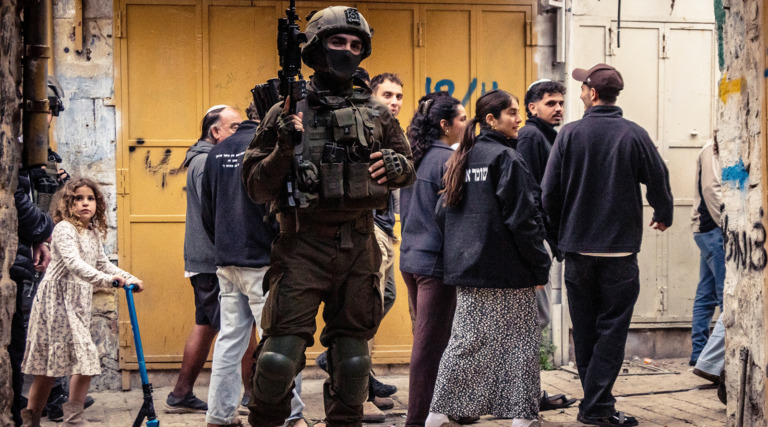
Pic: Hebron, West Bank, Palestine. 14th February, 2026 Israeli soldiers escort and protect settlers. An army patrol maintains security and order in the heart of the old Palestinian city of Hebron. Jose HERNANDEZ Camera 51 / Shutterstock.com
Sorry, no records were found. Please adjust your search criteria and try again.
Sorry, unable to load the Maps API.
It has been variously hailed and condemned as the most significant shift in Britain’s posture in the Middle East in recent decades. The announcement this week by new Prime Minister Andy Burnham that the UK is going to ban imports from Israeli settlements in the occupied West Bank has sent shock waves through the international community. The reaction from Israel has been swift and angry, but it can hardly have come as any surprise.
Labour Party members have long been clamouring for a far stronger response to illegal Israeli incursions into Palestinian territory than Sir Keir Starmer was prepared to offer; just this summer around 140 Labour MPs went public with a demand for sanctions, leading Burnham to say explicitly in July that “Labour’s initial response to the treatment of Gaza caused huge hurt. We got it wrong and I am sorry about that.”
Calling a halt to the import of the dates, mangoes, avocados, grapes, and herbs being grown in these illegal settlements may seem like a small inconvenience to the UK population, but the implications go much further.
The UK is an important trading partner for Israel as a whole, with trade between the UK and Israel totalling six billion pounds ($8.1bn) in 2025, according to the House of Commons. While it is difficult to estimate exactly how much of this is from goods produced by settlements, an estimated 38 million pounds ($51.4m) worth of goods was imported from the occupied territory in 2025, Parliament records show.
The UK is also reliant on Israel for a very wide range of goods including precious stones and metals, technical and medical equipment, plastics and machinery, in return for which Israel is a major customer for our defence equipment including drones, helicopters and aircraft components.
As well as being a significant global economic power, Israel is also an alleged nuclear power, so no-one has been particularly anxious to confront its external policy strategies.
As with most embittered conflicts, the enmity between Israel and Palestine goes back more than a century. In the aftermath of the First World War there was no shortage of territorial and political issues to resolve, but few proved more contentious than the dissolution of the Ottoman Empire, a state that spanned much of Southeastern Europe, West Asia, and North Africa from the 14th century to the early 20th century, centred in modern-day Turkey.
Even before the outbreak of the war the empire had suffered a catalogue of disastrous military defeats, at the same time that internal political divisions were tearing it apart. Partitioning of the empire began with the Treaty of London in 1915 and – as concerns for the populations within the region deepened – Britain issued the Balfour Declaration in 1917, which supported creating a “national home for the Jewish people” in Palestine, rather than establishing an independent Palestinian Arab state.
After the war Britain governed the region under a League of Nations mandate known as Mandatory Palestine, with Britain handing the unresolved political conflict over to the United Nations in 1947.
For its part the UN proposed partitioning the territory into separate Jewish and Arab states, which led to the 1948 war and the creation of the State of Israel, without a corresponding independent Palestinian state being formed – which is the essence of the conflict still raging today.
Dissecting the complexities and injustices of the past and attempting to force some form of peaceful solution has confounded even the most capable of legislators, so the tendency has been to fall back on what’s known popularly as the “two-state solution”, a not unreasonable strategy which seeks to recognise the arguments and grievances of both sides, in return for compromises and accommodations that will somehow ensure both populations have a place to live and safe borders.
It’s a plan that’s fine in principle, but flounders when one nation believes the other has no right to exist at all, and the other thereby recognises a very existential threat to its survival. A prolonged, bitter and inevitably futile state of warfare is the obvious outcome, which is where we are today.
For Burnham and his Labour Party, they’re clearly pinning their hopes and diplomatic efforts on reviving the two-state solution, and the hope that this will be supported by the British public when the going starts to get tough. Unfortunately, Britain has now become a widely diverse and politically and morally fragmented country, so presumptions of coherent and consistent public support are sadly very much a thing of the past. However, intervening in the plight of the Palestinian people is one issue on which the public has considerable empathy, and that’s what Labour is pinning its hopes on.
For Catholics there are equally complex considerations when it comes to where we stand on the issue. This week’s sanctions against violent settlers and illegal settlement activity are politically contentious but the principles behind them — protection of civilians, opposition to dispossession, respect for international law and defence of a two-state solution — have striking parallels with the position consistently articulated by the Holy See. For us, it doesn’t matter which political party is making an argument; the first question is whether the objectives being described can be reconciled with the moral principles proclaimed by the Church – and there is a strong argument that they can.
Key to the Catholic position is the separation of the actions of the current Israeli administration and the people of Israel themselves. This was something that yesterday Foreign Secretary Ed Miliband was at pains to make clear – the measures being taken target settlement activity rather than Israel itself, they are proportionate and normal trade with Israel within the Green Line will continue. This is important because Catholic theology rejects attempts to hold Jewish people collectively responsible for decisions made by the Israeli Government, just as the Palestinians are not responsible for the crimes of Hamas – in much the same way that the Catholic population in Northern Ireland ought not to have been held accountable for the atrocities of the IRA.
Of course, one of the problems during the Troubles was that the Catholic community itself was often reluctant to condemn such violent acts, providing a convenient excuse for protagonists to conflate the two. The present situation is a close parallel and – whilst the British Jewish community is perfectly right to worry that certain groups may now hold them communally responsible for the actions of the Israeli government – an unambiguous public rejection of those policies just now would do a great deal to negate such dangers.
For its part Christianity rejects antisemitism, and the Church’s teaching on the dignity of the Jewish people is unequivocal. It should also be said that the Church has condemned utterly the Hamas atrocities of 7th October 2023 and has repeatedly demanded the release of hostages. Pope Francis described the murder and kidnapping of innocent Israelis as terrorism and extremism.
Yet recognising Israel’s legitimate security needs does not require Catholics to remain silent about injustice against Palestinians. Indeed, Catholic social teaching requires precisely the opposite.
The Church’s position begins with a principle easily lost amid political slogans: both Israelis and Palestinians possess human dignity and legitimate aspirations. The Holy See has long defended Israel’s right to exist in peace and security while also supporting the Palestinian people’s right to a sovereign homeland, and this is why successive popes have supported a two-state solution. This was the view of Pope Leo just last month, when he urged the international community to advance a two-state solution leading to a “just and lasting peace” – two peoples living in two states, with the legitimate rights of both protected.
This is why there is such concern about Israel illegally occupying Palestinian land, and doing so in a way that specifically annexes the chances of the creation of a legitimate Palestinian state. If Palestinians have a genuine right to a viable state, policies which progressively make such a state impossible cannot simply be regarded as neutral facts on the ground.
At the United Nations in 2024, Cardinal Pietro Parolin, the Holy See’s Secretary of State, specifically included Israeli settlements in Palestinian territories among the unilateral actions that must be abandoned. He simultaneously insisted that terrorism, violence and coercion must cease. Parolin’s approach is characteristically Catholic, because justice is not achieved by deciding that one people is innocent and another guilty. Israelis are not abstractions, nor are Palestinians; they are human beings, families and communities whose lives cannot legitimately be sacrificed to competing nationalisms.
Archbishop Paul Gallagher, the Holy See’s Secretary for Relations with States, who has been involved in a lengthy and sustained diplomatic effort to bring the warring parties together, reiterated at the United Nations last year that peace between Israel and Palestine must be founded upon international law and relevant UN resolutions.
This principle reflects something far more than just casual diplomacy. Catholicism rejects the proposition that might makes right but rather holds that political power is morally accountable. Property, sovereignty and security may be important goods, but they exist within the requirements of justice and the universal dignity of the human person. For that reason, Catholics are particularly concerned when civilians are driven from their homes through intimidation or violence, whoever the perpetrators may be.
The Catholic Church’s theological understanding of the Jewish people and Judaism is very positive—especially since Nostra Aetate—but recognition of the Jewish people’s religious significance is not treated as theological authorisation for Israeli territorial expansion.
During his recent visit to Moscow, Archbishop Gallagher also made this same point in the context of Vladimir Putin’s illegal occupation of Ukraine, and what is needed to achieve a peaceful solution to the conflict there. In Catholic theology peace is not just the absence of shooting and killing; it requires that justice is achieved by all concerned. A Christian concept of justice has nothing to do with temporal rights and retribution, but everything to do with creating the conditions in which human beings can live securely, raise families, practise their faith, possess homes and property, and participate in the political life of their community without living under permanent fear.
So it is in the Middle East: not only do the Israelis deserve that peace, but the Palestinians too, and the world should be insisting upon the dignity of both peoples simultaneously. That is the Catholic definition of a meaningful and lasting peace; anything less is simply not acceptable, and an affront to our God-given human dignity.
Joseph Kelly is a Catholic writer and public theologian
Pic: Hebron, West Bank, Palestine. 14th February, 2026 Israeli soldiers escort and protect settlers. An army patrol maintains security and order in the heart of the old Palestinian city of Hebron. Jose HERNANDEZ Camera 51 / Shutterstock.com